Pages

Showing posts with label Guest author. Show all posts

Wednesday, 22 January 2020

What a small country’s successes and mistakes can teach us about emission pricing

By Suzi Kerr, Chief Economist at Environmental Defense Fund. First published at EDF's blog.

I’m from Aotearoa, New Zealand, and I really love its land and people, but I am fully aware that from a global perspective it appears pretty insignificant – that’s actually one of its charms.  But being small doesn’t mean you can’t make big contributions including toward stabilizing the climate. This recently published article highlights some lessons New Zealand’s experience with emissions trading can offer other Emissions Trading System (ETS) designers at a time when effective climate action is ever more urgent.

Talking intensively to ETS practitioners and experts around the globe about their diverse choices and the reasons why they made them has made me acutely aware of the need to tailor every ETS to local conditions.  In a complex, heterogeneous world facing an existential crisis, diversity in climate policy design makes us stronger and frankly, improves the odds that the young people we love will live in a world where they can thrive.

Wednesday, 31 January 2018

Approaching a Low-Emission Future: Emission Trading Scheme vs. Command-and-Control Approaches in New Zealand

By Rosemary Irving and Rosa Hill, University of Canterbury 
Rosie and Rosa are undergraduate students. They won the Motu Environment Economics Essay prize in 2017. You can find out more information about Motu's proposal for the Emissions Trading Scheme (ETS) and our wider ETS work.  

Rosie Irving and Rosa Hill
Achieving emission targets can be accomplished through numerous policies; however, some of these policies are more efficient and cost effective than others. Here in New Zealand, we currently run an ETS. Economic rationale supports an ETS policy as being more efficient as opposed to a command-and-control approach for a number of reasons which we will explore in depth below. 

Economic Rationale: How an Emissions Trading Scheme Works

Figure 1: Command-and-control (equal
misery) approach  
 Figure 2: Emissions trading scheme
approach  


Monday, 7 August 2017

Vast majority of New Zealanders want action and leadership on climate change.

Guest post from Pure Advantage first posted here.

Following the US announcement that they would withdraw from the Paris Climate Change Agreement, we asked if New Zealand should follow suit. A whopping of 92 percent of Kiwis disagreed, not wanting our country to follow President Trump’s decision. New Zealanders are even more united in their commitment to the Paris Accord than Australians who show 87 percent support.

Last week, Pure Advantage released the results of their Climate Survey which talked to 1000 New Zealanders about their perspectives on New Zealand’s climate policy position. The results show that a vast proportion of New Zealanders have the appetite required to effect change and reduce our greenhouse gas emissions.

Friday, 28 April 2017

New report highlights need for coastal homeowners, government, and the insurance industry to plan for climate change

by Susan Livengood, Director of Partnerships for the Deep South National Science Challenge.

As New Zealand counts the cost of widespread flooding this month, a new report identifies key questions we need to answer to better prepare our coastal communities for climate change.

The Insurance, housing and climate adaptation report, commissioned by the Deep South National Science Challenge, highlights issues New Zealand may face as it grapples with “increasingly severe risks” for coastal housing – particularly sea level rise which is expected to exacerbate the frequency and impacts of flooding and storm surges.

It was hard not to think of this report as I drove along the Thames Coast Road in the wake of last week’s storms. Huge boulders lay on the road, pohutukawa trees ripped from the earth by landslides lay dying in the sea, and the splash of waves on the road reminded me just how susceptible to sea level rise this area is.

Wednesday, 15 February 2017

International transfers of mitigation to achieve the goals of the Paris Agreement

By Suzi Kerr (Motu Economic and Public Policy Research) and Mike Toman (World Bank)

More than a year has passed since the signing of the Paris Agreement under the United Nations Framework Convention on Climate Change, in which developed, emerging and developing countries across the world have pledged to limit or reduce their greenhouse gas emissions (GHGs) as a start toward limiting dangerous climate change. Under the Agreement, countries can work together to reduce emissions. 

Mike Toman, a Lead Economist in the World Bank’s Development Research Group, and Motu’s Suzi Kerr have come up with three basic guidelines for financing of emissions reductions in less economically advanced countries:
1. Do not conflate “international carbon markets” with “internationally transferred mitigation outcomes.”
2. Be cautious about the apparent gains from linking emissions trading markets.
3. Create contracts between developed and developing country governments for internationally transferred mitigation obligations.

Monday, 19 December 2016

New emissions reduction plan business as usual

By Ralph Sims. Reprinted with permission from Carbon News

The Government’s plan to cut the emissions intensity from industrial heat generation  by 1 per cent a year is just business as usual, and will do little to achieve New Zealand’s Paris Agreement commitment.

Ralph Sims is Professor of Massey University’s School of Engineering and Advanced Technology, an IPCC lead author and consultant to the International Energy Agency. He is an expert on renewable energy deployment and policies, distributed energy (including smart grids), biomass supply chains and bioenergy conversion, biofuels for transport andclimate change and renewable energy scenarios.

There is a major disconnect between New Zealand’s international commitments under the Paris Climate Agreement and the recently released draft for consultation of the NZ Energy Efficiency and Conservation Strategy for 2017 to 2022.

Tuesday, 30 August 2016

Creating Trust and Transparency in Fossil CO2 Emissions Reporting

by Jocelyn Turnbull, Senior Scientist, GNS Science
Marcus Trimble and Margaret Norris using the GNS Science high-tech grass sampling method near the Kapuni plant in Taranaki. A GPS, a plastic bag and a marker pen are all that is required. And perhaps a pair of gumboots! Photo credit: Jocelyn Turnbull, GNS Science.
Last year, I wrote about how we can use atmospheric measurements to determine whether nations and industries are meeting their fossil fuel CO2 emission reduction goals. With the Paris Agreement, the stakes have gotten higher, with most nations agreeing to reduce their emissions, and a recognized need for “trust and transparency” amongst nations in emissions reporting.
This week, GNS Science published a new research paper taking the concepts I talked about in my previous post, and turning them into a specific method that evaluates emissions from individual power plants to better than 10% accuracy. This is key because power plants are the biggest emission sources (the huge Taichung coal-fired power plant in Taiwan produces more fossil fuel CO2 than all of New Zealand!). This makes them an obvious target for regulating and reducing emissions. 
In the past there have been considerable barriers to measuring emissions rates from power plants. Radiocarbon measurements that need to be used in this process are time-consuming and expensive. Additionally, the atmospheric models used to translate fossil CO2 concentration measurements to emission rates from the power plant are most accurate when averaged over long time periods.
To remove these barriers, the scientists at GNS came up with the idea of using living grass as sample collectors. There is no special field sampling equipment required, and grass effectively collects a radiocarbon sample averaged over the many days it grows. A single grass measurement tracks a week or so of emissions and is a perfect complement to the optimal model averaging period. These innovations allow us to measure the power plant emission rate to 10% accuracy. This is a marked improvement over the ~20% reported by individual power plants (based on their methods). That ~20% also doesn't take into account any bias in the plants' self-reporting. 
Grass growing in farmland near the Vector Kapuni plant in Taranaki makes an ideal sampler for fossil CO2 emissions. Photo credit: Jocelyn Turnbull, GNS Science.
This simple and low-cost method was developed using the Kapuni processing plant in Taranaki as a test case and can be readily applied around the world. 

Wednesday, 11 May 2016

Can Engineers Change the World? Energy Transition Engineering

Dr Susan P Krumdieck is Professor in Mechanical Engineering and Director of the Advanced Energy and Material Systems Lab, University of Canterbury, New Zealand.

Can technology solve the climate problem? Dr Krumdieck outlines her work on a new interdisciplinary practice called transition engineering: changing course one innovative project at a time.

Business leaders recognise that the biggest risk to their business is energy transition. The most popular concept of this transition involves a substitution of renewables for fossil fuels and development of elusive tail-pipe technologies like carbon-capture and storage. This concept is comforting and simple. But it is also profoundly wrong. There is no way to achieve an energy transition without completely reworking every aspect of our infrastructure, industry and economy to vastly reduce energy demand. Changing the global economy to nearly eliminate the use of fossil fuels is a “wicked problem” – a problem with no known solution. This is why the new field of energy transition engineering is emerging. 

Can engineers change the world?

Thursday, 25 February 2016

ETS Review Submission from Adrian Macey

Guest Post by Adrian Macey, Senior Associate, Institute for Governance and Policy Studies, Adjunct Professor, New Zealand Climate Change Research Centre, Victoria University of Wellington, Vice Chair then Chair, UN Kyoto Protocol negotiations 2010-2011, New Zealand Climate Change Ambassador 2006-2010, Chief Trade Negotiator 2000-2002.

This is a direct transcript of Adrian Macey's submission to the ETS Review. You can also check out Motu's submission and that of Z Energy.


General points

The discussion paper is a good overview and addresses some important longer term issues. The minister’s introduction correctly identifies the purpose of the ETS as the gradual transition to a low emissions economy.  

The Paris Agreement shifts the focus to domestic measures more than international compliance, and this needs to be reflected in the fundamental orientations of the ETS.

Wednesday, 10 February 2016

Family and the Fossil Carbon Safety Margin

by Dr. Susan P. Krumdieck, Professor in Mechanical Engineering, University of Canterbury

In my previous blog, I translated the current language of the 2oC climate change target into an engineering concept of a global warming “failure limit” associated with carbon fuel production.  For this part of the analysis, I will use the units more commonly used by the media – GtCO2 – which means the cumulative emissions failure limit to maintain temperature rises below 2oC is around 3000 GtCO2 with a probability greater than 66%.

Suffice it to say that a 2oC temperature rise would pose an unacceptable risk to our civilization and most of the world ecosystems. That seems quite a dramatic claim, but there is pretty good certainty that the heat input involved in that 2oC temperature change would be sufficient to melt global ice, raise the sea level and cause uncertainty enough to risk, alter, damage, or destroy 80-90% of the investment in real estate, infrastructure, agriculture and organization that humanity has made to date. It will also mean a mass extinction of species and climate chaos. By “climate chaos” I mean the occurrence of storms, droughts, high temperatures, low temperatures, rainfall, hail stone size, and tornado size that are “unprecedented” and can’t be managed by historical hazard mitigation measures.

I wanted to make this personal by considering the history of CO2 emissions against the human scale of seven generations of my family. As an engineer, I don’t think of safety limits as “targets.” Failure to reduce fossil fuel production to nearly zero in my lifetime will mean unacceptable hardship for people I know. So how did we get to this point?

Tuesday, 9 February 2016

Fossil Carbon Safety Margin

by Dr. Susan P. Krumdieck, Professor in Mechanical Engineering, University of Canterbury

To me, as an engineer and a person with a family, the language of climate change action – for example setting “targets” for emissions – seems to be dangerously at odds with the science.

It seems obvious that the engineers of the world have a lot of work to do in changing everything that uses fossil fuel to use much less to no fossil fuel. However, this discussion is not really taking place. 

The science is clear, so I wanted to look at how we might use the language of engineering to understand the way forward. The latest IPCC Fifth Assessment Report gives conclusive modelling and science observation that profoundly affects every person on the planet. However, the general population doesn’t seem to understand the message. 

Monday, 2 November 2015

Clearing the air on methane

by Zack Dorner

Agricultural emissions, caused in part by lots of cows and sheep burping, are responsible for around half of all of New Zealand’s greenhouse gas emissions. New Zealand faces “unusually high costs to cut greenhouse gas emissions” due to the large number of livestock in the country, or so the government is continuing to argue. With Suzi Kerr, I’ve just released a Motu Working Paper looking at methane emissions from NZ agriculture, which comprise 30% of NZ’s agricultural emissions (with 18% being from nitrous oxide), so it seems timely to look at some of the issues regarding methane, and hopefully clear the air on this confusing and complicated topic!

Thursday, 24 September 2015

The virtue of sunlight

Guest Post by Adrian Macey, Senior Associate, Institutefor Governance and Policy Studies, Adjunct Professor, New Zealand Climate Change Research Centre, Victoria University of Wellington, Vice Chair then Chair, UN Kyoto Protocol negotiations 2010-2011, New Zealand Climate Change Ambassador 2006-2010, Chief Trade Negotiator 2000-2002.

Among the many challenges climate change policy in New Zealand faces is knowing the costs and benefits of alternative pathways to a low carbon economy. The need to contribute a fair share of the international effort on climate mitigation adds a dimension that will be at the fore during the Paris climate conference in December (COP 21). 

Many factors can be taken into account in assessing transitions and contributions, but economic analysis and modelling (e.g. of mitigation potential, effects on households, on sectors, on GDP) are essential. 

The New Zealand Treasury advocates a simple burden-sharing principle for the international contribution: equal percentage GDP costs. In the government’s consultation preceding the announcement of the 2030 target and “INDC” (the international contribution) there were assertions about the relative cost of our contribution against those of the US and the EU. But neither these assertions nor the absolute cost figures were accompanied by any information with which to verify them. The full set of assumptions was not shown. Any benefits were excluded from the calculations. There was also a curious and unexplained decision to exclude forestry and agriculture from the figures (see below). 

Tuesday, 4 August 2015

From Sea to Shining Sea: US Cap-and-trade Programs Showing Success on Both Coasts

By Katie Hsia-Kiung, High Meadows Research Fellow, US Climate and Energy Program, Environmental Defense Fund

When the preliminary plans for California’s cap-and-trade program were first introduced in 2010, it was quickly regarded as a groundbreaking policy due to its stringency, size, and scope. California was the ninth largest economy in the world – it has now jumped to eighth – and the Golden State’s program would soon implement the first economy-wide cap on greenhouse gas pollution in the country. But, it was not the first cap-and-trade program in the United States. In fact, ten states in the northeast had implemented the Regional Greenhouse Gas Initiative (RGGI) in 2008. Like California’s program, the RGGI system places a mandatory cap on greenhouse gas emissions and sets a corresponding price on carbon, but covering only the electricity sector. Despite the difference in scope and location of these two programs, they are both demonstrating that carbon pricing through cap-and-trade is an effective way to decrease harmful greenhouse gas pollution while allowing the economy to grow.

Wednesday, 22 July 2015

Beyond Flying: Rethinking air travel in a globally connected world (a review)

What might a low-emission future mean for how we travel by air?  


This post presents a review of the book Beyond Flying: Rethinking air travel in a globally connected world, which was edited by New Zealander Chris Watson and published by Green Books in 2014.  The review, written by Rose Bridger, was first published in The Ecologist and is reprinted here with permission.

Beyond Flying brings together contributions from 14 people who drastically cut flying, or stopped altogether.

They made this commitment because flying is one of the fastest growing sources of climate disrupting greenhouse gas emissions. A single flight cancels out lifestyle efforts such as plant based diets, energy efficient homes and recycling.

In recounting experiences of undertaking long intercontinental journeys, and running businesses which require international communication, the book is an antidote to travel journalism which has no regard to the impacts of flying.

Monday, 15 June 2015

A call for ideas on the kind of a low-emission future we want, and actions we can take to make it happen

This is an open letter by nine authors participating in Motu's Low-Emission Future Dialogue. It originally appeared on interest.co.nz, here, and has been cross-posted with permission.

Dealing with climate change is difficult, there is no denying that.

Thankfully as a nation we have moved past denying climate change itself. Now we are debating the best way to deal with it. That much is progress.

The contributors to this article are part of a group of people that meets regularly to discuss climate change and how we might deal with it as businesses, academics, non-government organisations and individuals.


We don’t always agree on what needs to be done, but we do agree that climate change is a huge issue that will shape the future of our nation.

Thursday, 7 May 2015

Ontario on a Tear with its New Climate Proposal


By Derek Walker, Associate Vice President of the Environmental Defense Fund. Cross-posted from the EDF with permission. View the original post here.

Once upon a time, an international agreement forged through the United Nations Framework Convention on Climate Change (UNFCCC) seemed the surest route to meaningful action on climate change. But the complexities of reaching common ground between nearly 200 distinct national agendas have dimmed the hopes for the sort of “global deal” envisioned in the run-up to the Copenhagen conference in 2009. The UN process has provided a platform for countries to make new emission reduction commitments: Mexico recently announced a promising post-2020 climate commitment, and the US-China announcement last November was a game-changer. Even these critical breakthroughs, however, demonstrate that strong action on climate will be driven from the “bottom up” by national policies, not from the “top down” by an international treaty.

Thankfully, many leaders are blazing a path towards climate progress, working from the ground up and collaborating with others to foster collective action. As I have previously written, cities, states, and provinces are going ahead with some of the most substantial climate commitments to date. Ontario – Canada’s largest province, with 40 percent of the country’s population and nearly one-quarter of its greenhouse gas emissions – has become the latest jurisdiction to chart an ambitious path forward with this morning’s announcement of a comprehensive cap-and-trade program intended to ultimately link with the existing California-Quebec system.

Tuesday, 28 April 2015

Reflections on the international climate negotiations

By Chris Bean 

Chris Bean observed the 2014 round of the UN climate negotiations in Lima as part of the NZ Youth Delegation, a volunteer organisation that brings youth closer to the negotiations.

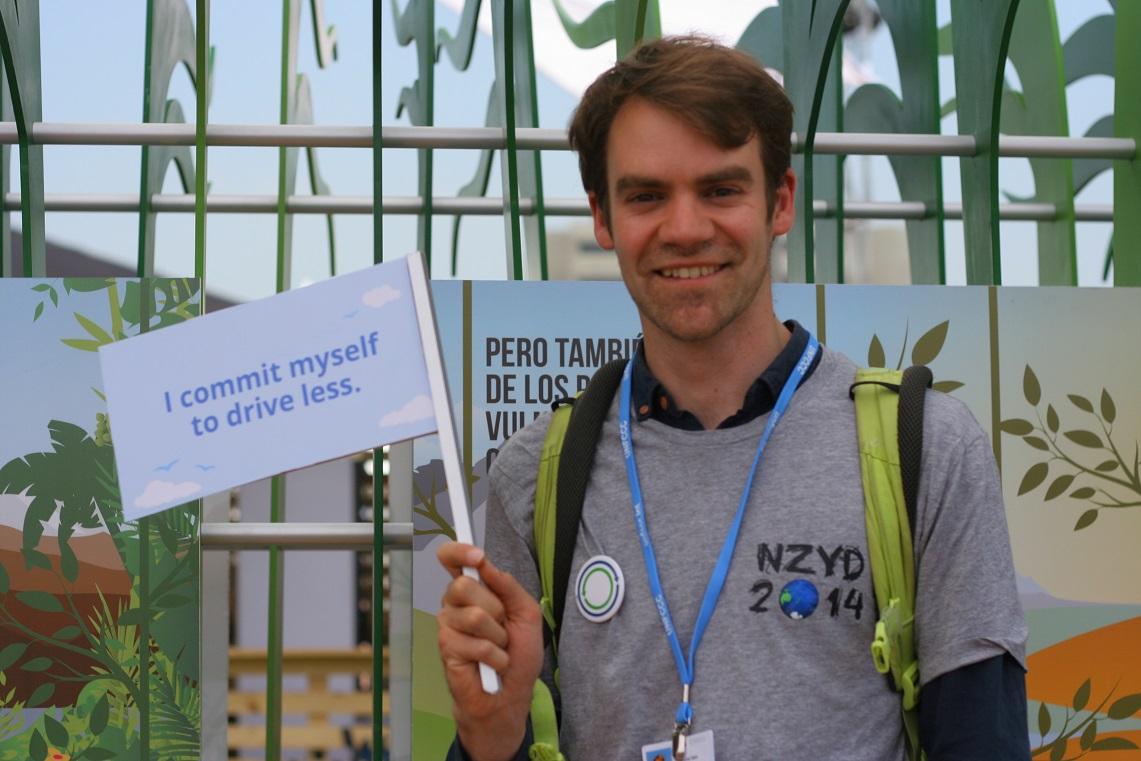
Having studied climate change for part of my undergraduate degree, going into the negotiations as an observer I thought I had a pretty solid handle on things. Well, it turns out that humble pie became a staple at the negotiations. I had the privilege of attending the UN climate negotiation round as part of the NZ Youth Delegation in December 2014 and this blog covers some personal experiences that defined the negotiations for me, as well as some observations of the broader process and what’s coming next on my journey with climate change.

Confusion was the overwhelming feeling during the initial days of the negotiations. Forget solving climate change for now – it took me two days to figure out how to use the scheduling system. Embarrassing! After talking to some more experienced people at the negotiations, I learned this was not unusual and that it takes multiple rounds of negotiations to really get one’s head around what is going on. I have overwhelming respect for everyone involved in the negotiations, especially the negotiators and UN staff who have dedicated their lives to this work, as well as the youth driven to follow the negotiations year after year to push for outcomes that affect us all.


Tuesday, 21 April 2015

The climate may be changing in climate change


This piece, by political analyst Colin James, originally appeared in the Otago Daily Times on 14 April 2015. It is also available for download on Colin's own blog, http://www.colinjames.co.nz/the-climate-may-be-changing-in-climate-change/


After the world cricket cup superhyperbole comes heroic Gallipoli. Periodically New Zealand mutates into Jingoland.

On Saturday our soldier Governor-General and non-soldier Prime Minister open the Pukeahu National War Memorial Park. That day Te Papa launches "Gallipoli: The scale of our war", designed by Weta Workshop's Sir Richard Taylor, with videos.

That collaboration exemplifies Te Papa chief executive Rick Ellis's entrepreneurship. Ellis is developing non-jingo projects to project unique aspects of our culture and identity, including the bicultural accommodation, with events and collaborations here and abroad.

Tuesday, 17 March 2015

The Global Calculator: Crunching the numbers for a low-emission future

By Paul Young, Generation Zero

Paul Young is a co-founder of the youth climate change organisation Generation Zero and remains involved as a member of the national executive. He is also a trustee of the National Energy Research Institute, the modelling team leader for the NZ 2050 Pathways project, and a participant in the Motu Low-Emission Future Dialogue.

“Hate wind farms? Eat chicken, not beef” - The Telegraph, 28 January 2015

Despite the baiting headline from a newspaper known for its doubtful position on man-made climate change and antagonism towards wind power, the team behind the newly-launched Global Calculator marked this coverage as a success.

The Telegraph had picked up on one (rather surprising) conclusion from the Global Calculator: cutting global beef consumption by 100 grams per week per person and eating chicken instead would “do more to tackle climate change than building two million onshore wind turbines and 2,000 nuclear reactors.” This results not just from the direct reductions in farming emissions, but also the implications for land use which are captured in the Calculator model. It’s one great example of the kind of choices and trade-offs this remarkable tool allows us to explore and gain insight into.